The Ultimate Guide to the Society of Actuaries (SOA)
"Welcome to your ultimate counselor-guided resource for the SOA. If you want to specialize in life insurance, health insurance, or investments, the SOA is the globally recognized governing body you need."
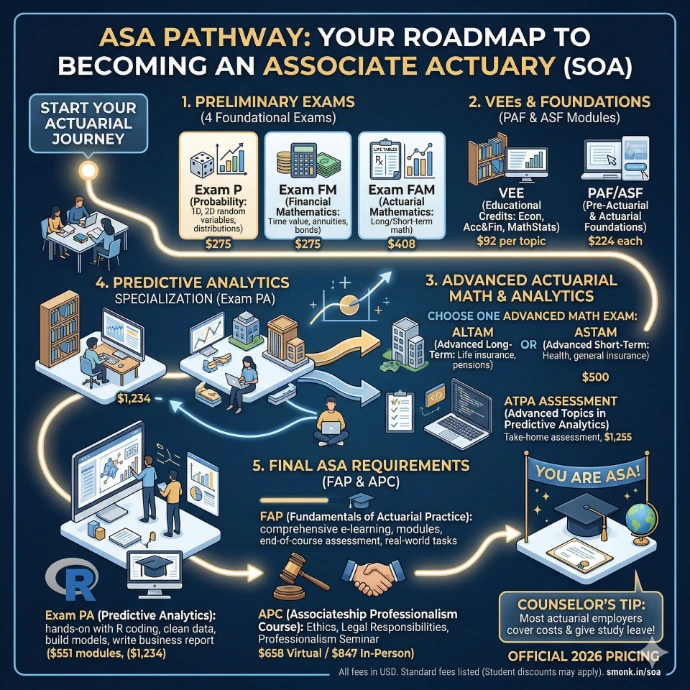
ASA Pathway
"The Associate of the Society of Actuaries (ASA) is your foundational tier. It proves you have mastered fundamental math, statistics, and business concepts."
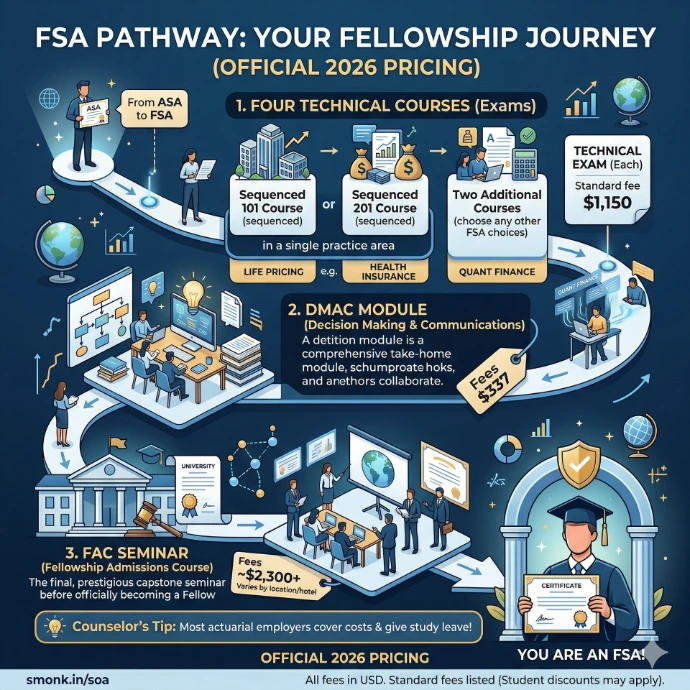
FSA Pathway
"The Fellow of the Society of Actuaries (FSA) is your expert tier. Earning your Fellowship means you are a specialized master in your chosen practice area."
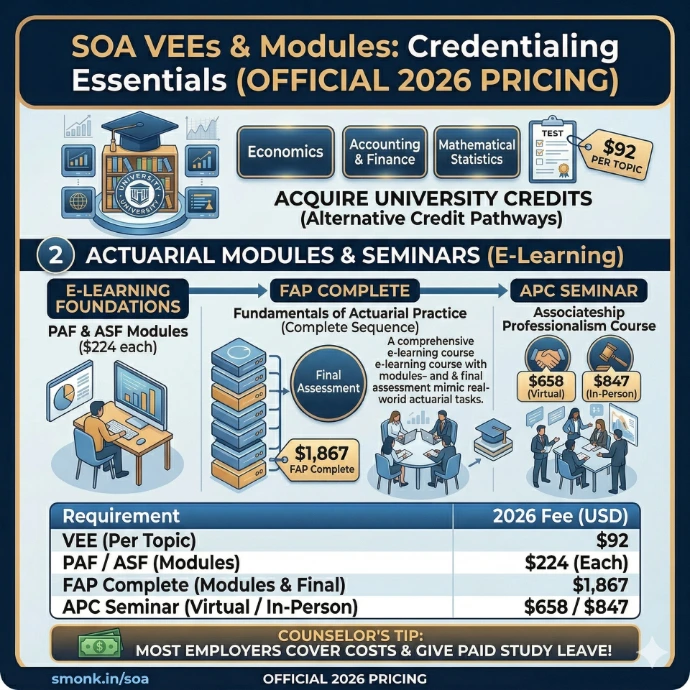
VEEs & Modules
"Alongside exams, candidates must complete Validation by Educational Experience (VEE) credits and e-learning modules to build practical skills."
The preliminary exams are the critical first step toward earning your ASA (Associate of the Society of Actuaries) designation. These rigorous, computer-based tests ensure you have mastered foundational actuarial mathematics, statistics, and business concepts. Core preliminary exams include Probability (P), Financial Mathematics (FM), Fundamentals of Actuarial Mathematics (FAM), Advanced Topics (ASTAM/ALTAM), and Predictive Analytics (PA).
Beyond the written exams, the SOA requires candidates to demonstrate practical knowledge and professional ethics. You will need to claim Validation by Educational Experience (VEE) credits in subjects like Economics, Accounting, and Finance. Additionally, candidates must complete the Fundamentals of Actuarial Practice (FAP) e-learning modules and attend the Associateship Professionalism Course (APC) to officially become an ASA
Earning your ASA is a massive achievement, but the journey can continue! To become a Fellow of the Society of Actuaries (FSA), you will choose a specialized practice area such as Life Insurance, Health, Retirement Benefits, or Quantitative Finance. This final phase involves advanced track-specific exams, specialized e-learning modules, and the Fellowship Admissions Course (FAC) to recognize you as an expert in your chosen field.